“DESCEND TO 4,000 IMMEDIATELY!” — CHILLING ATC RECORDING FROM MONTHS BEFORE FATAL LEARJET 𝔠r𝘢sh RESURFACES
PALM BEACH COUNTY, FLORIDA — “That’s not moderate. Descend to 4,000 immediately.”
Those urgent words from an air traffic controller are drawing renewed attention after a Learjet 60 carrying nine people crashed in Florida, 𝘬iᩚlling everyone aboard.
The recording, which dates back to May 2026, involves the very same aircraft — registration N722BD — that went down on November 1 while traveling from Austin, Texas, to the Bahamas.
The resurfaced audio has raised new questions about the aircraft’s earlier encounter with severe turbulence, although investigators have not established any connection between that incident and the fatal 𝔠r𝘢sh.
 THE MAY INCIDENT: “THAT’S SEVERE TURBULENCE”
During a flight near Newark, New Jersey, in May, the Learjet crew contacted air traffic control after encountering turbulence that made it difficult to maintain altitude.
A female pilot described the conditions as “moderate chop” and told the controller the aircraft was unable to hold its altitude.
The controller immediately challenged that description.
“That’s not moderate. Descend to 4,000 immediately,” the controller instructed, while also warning the crew about another business jet operating nearby.
A male pilot also described the conditions as moderate chop.
But the controller continued to emphasize the seriousness of the situation.
“If you can’t maintain altitude, that’s not moderate. That’s severe turbulence. Are you experiencing severe turbulence?”
Both pilots responded, “Affirmative.”
When the controller later asked whether anyone had been injured, the female pilot replied that there were no injuries, but the aircraft was still experiencing severe turbulence.
The incident ended without a reported 𝔠r𝘢sh.
The aircraft’s registration was later confirmed to match the Learjet 60 involved in the November disaster. However, the identities of the pilots heard in the May recording have not been confirmed, and there is no verified evidence that they were the same pilots who died in the November 𝔠r𝘢sh.
 SIX MONTHS LATER, THE SAME JET WENT DOWN IN FLORIDA
On November 1, the Learjet 60 operated by Aurora Aviation, doing business as Upper Jet, departed Austin-Bergstrom International Airport in Texas, bound for North Eleuthera in the Bahamas.
There were nine people aboard: two pilots and seven passengers.
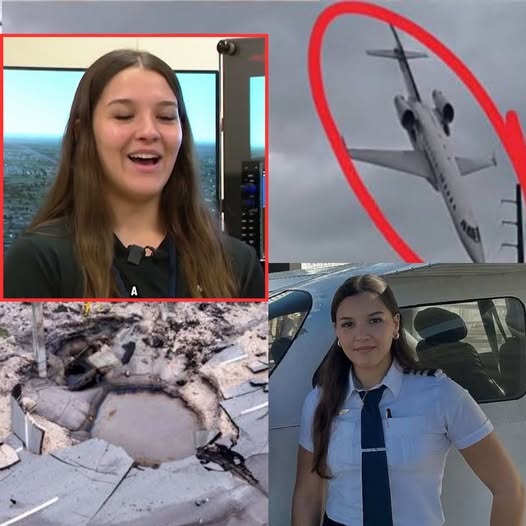
Shortly before 1 p.m. local time, the aircraft crashed near Greenacres in Palm Beach County, Florida.
The impact created a large crater and sent debris across a residential area. All nine people aboard were killed.
Among the victims were technology entrepreneur Adam Robinson, his wife, Helen, their two young children, Emma and Charlie, family friends Rachael Reed and Charmi Fehr, and the family’s nanny, Anita Maria Apellido Cetina.
The two pilots were identified as Jeffrey Gregory, 55, and Nathalia Gadelha Filgueiras, 20.
The tᩚraɢedy devastated the families of those aboard and prompted a major federal investigation.
THE FINAL FLIGHT: ICE, TURBULENCE AND A DESPERATE MAYDAY
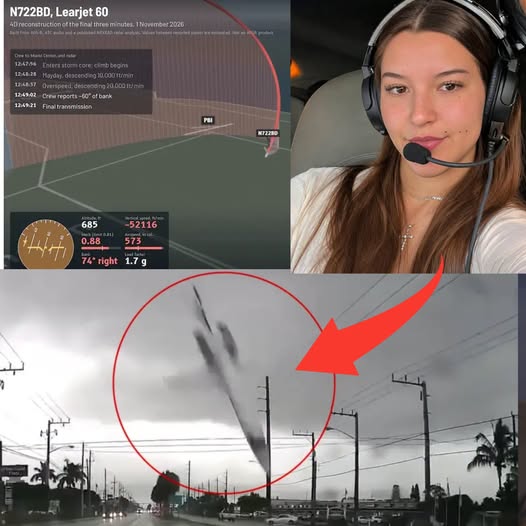
Air traffic control recordings from the November 1 flight captured the crew reporting light clear icing and moderate turbulence while cruising at approximately 35,000 feet.
The co-pilot described altitude fluctuations of roughly 600 to 700 feet and asked whether smoother conditions were available ahead.
The crew later reported entering precipitation and requested permission to climb to 37,000 feet.
Air traffic control approved the climb.
But less than 30 seconds later, the situation deteriorated dramatically.
The crew issued a Mayday call, reporting that the aircraft was descending at approximately 8,000 to 10,000 feet per minute.
The pilots subsequently reported an overspeed condition and a descent rate reaching 20,000 feet per minute.
The aircraft continued losing altitude as controllers attempted to communicate with the crew.
Investigators also found evidence suggesting that parts of the aircraft may have separated before the initial impact. Pieces of the tail’s elevator, which helps control the aircraft’s pitch, were discovered more than a mile from the main 𝔠r𝘢sh site.
NTSB RECOVERS THE COCKPIT VOICE RECORDER
On November 9, the National Transportation Safety Board announced that investigators had recovered the aircraft’s cockpit voice recorder from the initial impact site.
The device was transported to the NTSB’s Vehicle Recorders Laboratory in Washington, D.C., for evaluation.
The recorder could provide important information about conversations between the pilots during the final moments of the flight, including their response to the deteriorating weather and the aircraft’s sudden loss of control.
Investigators are also reviewing maintenance records, the aircraft’s previous mechanical history, weather conditions, flight data, air traffic control communications and the aircraft’s structural components.
The NTSB has not announced a final cause of the 𝔠r𝘢sh.
DID THE MAY TURBULENCE INCIDENT HAVE ANYTHING TO DO WITH THE 𝔠r𝘢sh?
That is one of the questions drawing attention following the resurfacing of the earlier recording.
The fact that both incidents involved N722BD has prompted aviation observers to examine the aircraft’s history more closely.
However, there is currently no confirmed evidence that the May turbulence encounter caused structural damage, that required inspections were missed, or that the earlier incident contributed to the November 𝔠r𝘢sh.
Investigators have not publicly established such a connection.
For now, the May recording remains a significant part of the aircraft’s publicly discussed history — not proof of what caused its final flight to end in tᩚraɢedy.
Nine people lost their lives aboard the Learjet, leaving families grieving and investigators searching for answers.
The most important evidence may now lie inside the recovered cockpit voice recorder and the aircraft components being examined by federal investigators.
The question remains: What happened aboard N722BD during its final moments — and could its earlier flight history help investigators understand the tᩚraɢedy?