Prosecutors revived a theory in the Lindsay Clancy murder trial case this week, suggesting she had faked a sᩚuᩚiᩚcide attempt after allegedly strangling her three children.
While prosecutors have been arguing that Clancy acted intentionally and should be held criminally responsible, her defense has said she suffered from postpartum psychosis.
To make their case, prosecutors pointed this week to internet searches made on the family computer in the months before the killings – including for “sᩚuᩚiᩚcide methods”, searches for psychiatric medications, detox programs, mania, ketamine therapy and concerns about a psychiatrist overprescribing medication.
Clancy’s cellphone revealed searches for “can you treat a sociopath?” four days before the killings, along with notes about depression, exhaustion and concerns over her relationship with her youngest child, Callan, who she struggled to breastfeed.
“I want to feel love and connection with all my kids … I just want to feel happy. I want to be able to relax and take care of my kids. And when they go to bed at night, I want to deeply relax and hang out with Pat and then fall into a deep sleep for 8 hours, get up and pour hard into myself for an hour and a half. Cal was so very planned and desired. I want to be able to give him all the love he deserves,” read an entry from Clancy’s notes app on 25 October 2022.
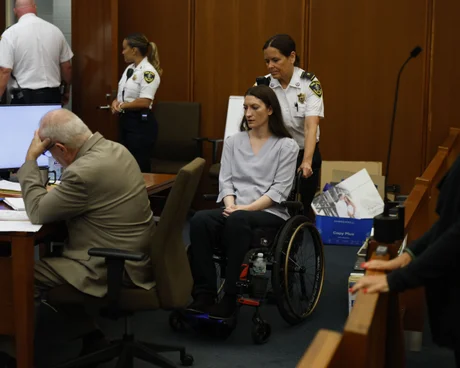
Lindsay Clancy murder trial: toxicologist testifies about medications found in defendant’s blood
Then, in a note created just prior to the killings and modified a day before they took place, Clancy wrote: “Medication stole my motherhood and my life … prescription medication stole me from my own body.”
In January 2023, the prosecution claimed Clancy made a series of internet searches, including one for “hallucinations” and “intrusive” a day later. Clancy, who had been prescribed 13 different medications and reported trouble sleeping, also searched for “premade goodie bags” and “best kids movies”.
On the day of the murders – which Clancy has admitted to but is pleading not guilty by reason of insanity, citing postpartum psychosis – the 36-year-old mum took the elder kids out to build a snowman, later texting her former-husband, Patrick: “Any chance you want to do takeout from Three-V,” referring to a local restaurant.

When Patrick responded “Yeah”, Clancy wrote back: “Okie dokie. Check the menu when you can.” Soon after, prosecutors claim, she strangled her kids with exercise bands.
Without a legal obligation to offer motive, prosecutors contend her actions – particularly in sending her husband out for a take-out and medicines on the evening of the murders – show she planned to 𝘬iᩚll her children.
But to her defense team and others, Clancy was a mom struggling to hold her life and family life together. Proceedings have shown Clancy to be suffering from both undiagnosed bipolar disorder and postpartum depression, to have been overly medicated by layers of poorly communicating healthcare professionals from who she had repeatedly sought help and ultimately someone who may have snapped under postpartum psychosis.
“The prosecution is arguing that this was a rational woman who liked to be in control, a mom who had her kids schedules, feeding schedules, and was so in control that when she started to lose it she was so frustrated that she killed the kids but when it came to 𝘬iᩚlling herself, she was a coward,” said Margaret McLean, a former Massachusetts prosecutor, aka the “Courtroom Translator,”
McLean pointed out that Clancy never told her doctors she was hearing voices that were directing her to 𝘬iᩚll her kids prior to doing so, though she had told a psychiatric nurse practitioner that she was having “intrusive thoughts I never had before”, and “feeling completely hopeless”.
The practitioner advised giving her medications more time to work. It was only when Clancy was in hospital after the murders that she told her husband she had “heard voices”.
While Shanan Buckingham, the prosecutor, has urged jurors not to view the Clancy trial as “a public debate about women’s mєntal health and how the medical system treats women”, it is inevitably becoming one in the court of public opinion.

Dr Gina Wong, a registered psychologist, a perinatal forensic expert and co-author of Maternal Filicide, a book on the phenomenon of mothers 𝘬iᩚlling their children, says the Clancy trial has, in some corners of social media, “become a spectator sport – stripped of nuance and rife with armchair diagnoses, moral certainty, sensationalism, misinformation and dehumanizing commentary”.
But the trial has also become a catalyst for what Wong calls “an overdue conversation” on the shortcomings in maternal mєntal health care.
“Too often, mothers in psychiatric crisis are missed, care is fragmented and coordinated assessment, family involvement, safety planning, specialized professional training and public education have been insufficient,” she says.
The trial, she says, shows “the need for more coordinated clinical responses to women whose perinatal mєntal health needs are escalating”.
“Perinatal mood and anxiety disorders (PMADs) are far more common that many people realize. The childbearing years represent the most vulnerable time psychologically, with psychiatric hospital admissions increasing markedly in the weeks after birth more than any other time in the female life cycle.”
But Wong, who is involved with says that a postpartum psychiatric crisis is not a predictor of violence, though “certain symptoms require rapid escalation, comprehensive risk assessment, and a rigorous level of coordinated psychiatric care proportionate to the danger”.
A mother who appears to be functioning but also going through a psychotic break is not inherently contradictory, she said. “Severe psychiatric disturbance and evidence of planning, organization or apparently ordinary functioning are not automatically mutually exclusive,” she said. “Apparent organization does not prove sanity.
“Psychosis is not always visibly chaotic,” she added. “Psychosis can fluctuate, and a person may retain some practical abilities that demonstrate cognitive organization, while having profoundly distorted beliefs or impaired judgment.”
The trial continues next week.