“HE PUT HIS HAND ON HIS HEART WHEN HE SAW THE HELICOPTER!” — 17-Year-Old William Found Alive After Six Days Lost in Australian Wilderness as Mum Reveals His Terrifying Ordeal
VICTORIA, AUSTRALIA — For six days, a mother waited for the sound of a phone ringing with the news she desperately wanted to hear. Her 17-year-old son had disappeared in the vast Australian bushland, and every passing hour brought more uncertainty.
There was no phone call from William. No message. No clear indication of where he had gone or whether he was safe.
But on November 12, 2026, an extraordinary discovery brought the search to an end.
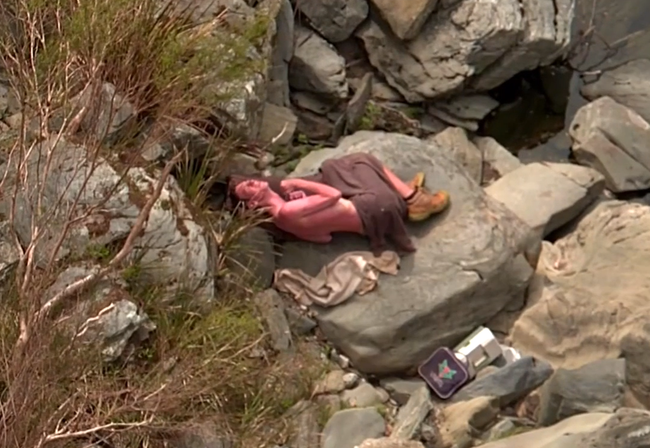
A Victoria Police helicopter spotted William lying on a rock beside a creek, sunburnt and exhausted but alive, after nearly a week alone in the wilderness.
And when the teenager realized the helicopter was there to rescue him, he reacted in a way that rescuers would never forget.
He placed his hand over his heart, raised his fist in celebration and prepared to leave behind the wilderness that had been his home for six terrifying days.
For his mother, Elizabeth Barkley, the moment meant something even greater: her son was coming home.
A WRONG TURN THAT TURNED INTO A NIGHTMARE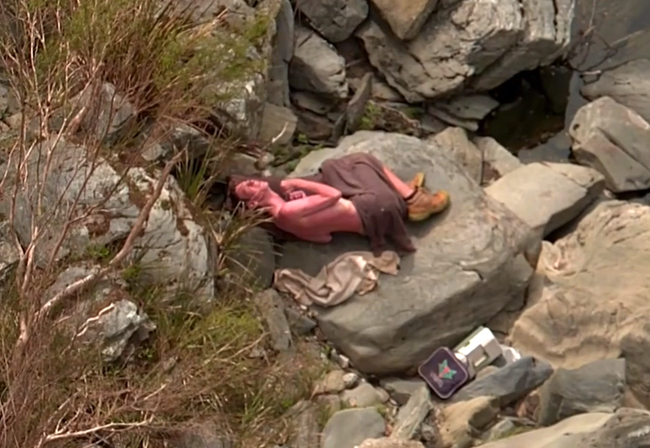
William disappeared on November 6 while camping near Walhalla East, in Victoria’s Gippsland region, approximately 180 kilometres east of Melbourne.
His mother had dropped him off near a campsite where he was staying with another teenager.
At around 4 p.m., William walked away to collect additional camping equipment. But after taking a wrong turn along a trail, he became separated from the campsite and could not find his way back.
William had never been camping before and did not have his mobile phone with him.
When he failed to return, concern quickly grew.
His disappearance triggered a major search operation involving Victoria Police, specialist search-and-rescue personnel, emergency services, police dogs and community volunteers.
More than 80 volunteers reportedly searched the surrounding bushland each day.
The terrain presented enormous challenges. Dense vegetation, steep slopes and rocky creek beds made some areas extremely difficult to access on foot.
As the search continued, Elizabeth held on to the belief that her son was still alive.
She later explained that she had a feeling in her heart that he would be found.
A PACKET OF CHIPS, CREEK WATER AND TWO TOWELS
When William’s survival story emerged, people were astonished by how little he had to rely on during those six days.
His mother revealed that he survived on a family-sized packet of Smith’s chicken-flavoured potato chips, which he rationed over approximately two days.
He also drank water from a nearby creek.
Without proper camping equipment, William used two towels and a pillow to help keep himself warm during the cold nights.
The conditions were far from comfortable.
He experienced freezing temperatures overnight, warmer weather during the day and significant sun exposure.
At some point, William also fell down a steep section of terrain, leaving him with scratches and sore legs.
His mother later explained that he remained in one location rather than continuing to wander through unfamiliar bushland.
That decision became an important part of his survival.
William had no idea how extensive the search operation had become or how many people were desperately trying to locate him.
He was simply waiting, hoping someone would eventually find him.
“COUNTRY ROADS” — THE SONG THAT KEPT HIM COMPANY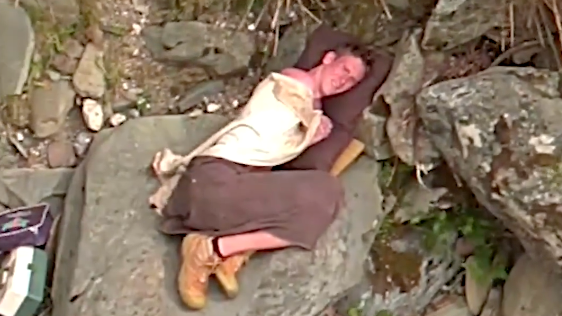
Perhaps the most touching detail of William’s ordeal was the way he tried to cope with the loneliness.
During the nights, he repeatedly sang John Denver’s famous song, Take Me Home, Country Roads.
His mother later explained that singing helped keep him entertained and gave him something familiar to focus on.
William also spoke about how the song made him feel better.
In a place where everything around him was unfamiliar, music offered a small connection to the comfort of home.
It was a simple thing, but during six long days without family or friends nearby, it became part of how he kept his spirits up.
The teenager later revealed that he had experienced moments of fear and uncertainty.
He was cold, hungry, thirsty and frightened.
But he continued holding on until help arrived.
THE DISCOVERY THAT CHANGED EVERYTHING
On the morning of November 12, Victoria Police’s Air Wing was conducting an aerial search around the Cowwarr area.
During the operation, officers spotted a fishing tackle box in the bushland approximately two kilometres from where William had last been seen.
The discovery prompted the helicopter crew to examine the surrounding area more closely.
Then they noticed someone lying on a rock near a creek bed.
It was William.
He had been sleeping when the helicopter approached.
As he realized the aircraft was there to rescue him, he woke up, waved toward the crew and celebrated.
The terrain was so steep and difficult that rescuers could not simply walk in and reach him.
A police flight officer was lowered from the helicopter, and William was eventually winched to safety.
After six days of searching, the missing teenager had finally been found.
Acting Inspector Jason Benbow later described the discovery as an extraordinary result, saying he believed William could potentially have survived even longer.
“OH, MUM, HEY!” — THE REUNION THAT ENDED SIX DAYS OF HEARTBREAK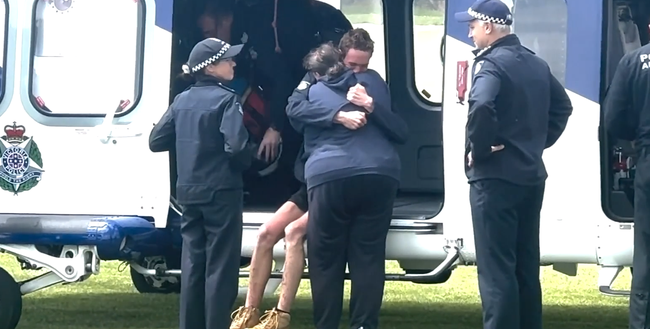
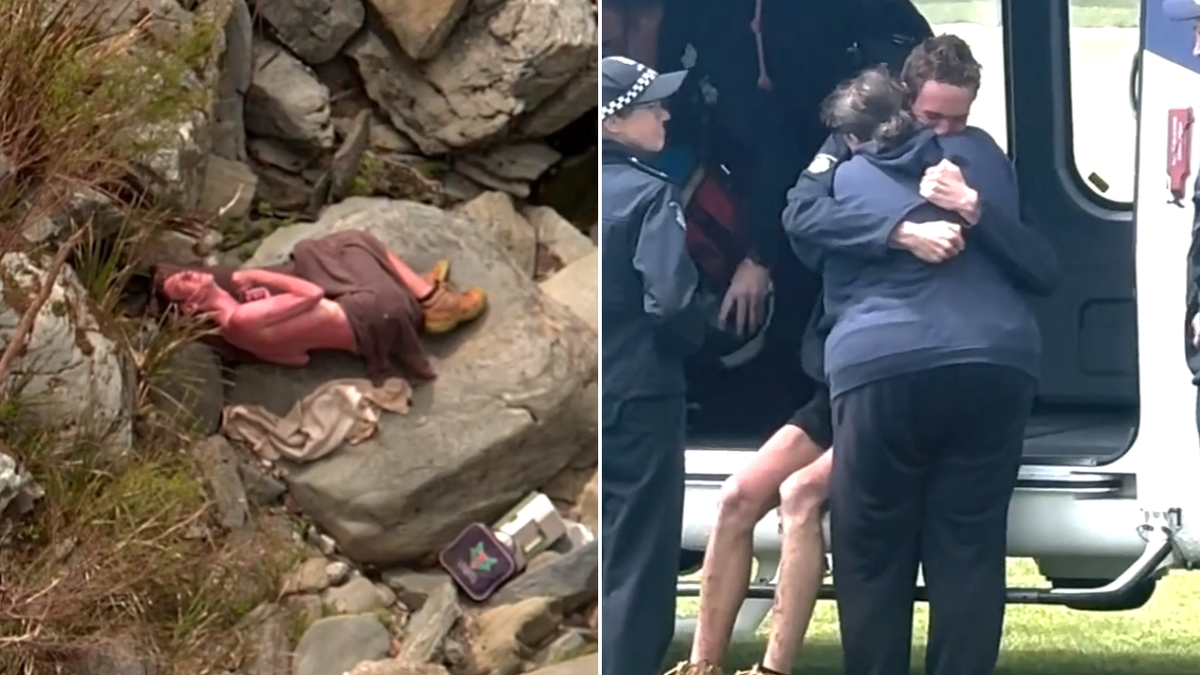
The helicopter returned William to the police command post at Cowwarr, where his mother was waiting.
Elizabeth had spent nearly a week hoping for this exact moment.
When the aircraft arrived, she rushed toward her son with open arms.
William greeted her with an emotional, familiar response: “Oh, Mum, hey.”
His mother immediately embraced him.
But Elizabeth also had a few words for her son after the frightening experience.
“Don’t ever do that again. You’re never leaving my sight again. You scared me,” she told him.
She even jokingly declared that he was grounded.
Behind the humour, however, was a mother who had spent six days terrified that she might never see her child again.
Speaking to reporters, Elizabeth said she had never stopped believing he was alive.
“I knew in my heart,” she explained.
She described the moment he was found as a miracle and expressed enormous gratitude to everyone who had participated in the search.
For the family, the rescue was the answer to nearly a week of prayers and uncertainty.
A MOTHER’S BIGGEST RELIEF — AND A VERY SPECIAL FIRST MEAL
After spending six days with almost no food, William naturally had one major request.
He wanted a big McDonald’s meal.
His mother revealed that he was craving a substantial order after surviving on potato chips and creek water.
However, doctors needed to monitor his recovery and make sure he could safely return to eating normally.
The teenager was taken to hospital shortly after the rescue for observation and treatment.
He was severely sunburnt, dehydrated and had scratches on his legs.
His condition also required further medical assessment after concerns were raised about possible damage to his windpipe.
His mother remained close by as doctors monitored his progress.
The family was grateful that he had survived, but his recovery was now the most important priority.
THE SEARCH THAT BROUGHT AN ENTIRE COMMUNITY TOGETHER
William’s rescue was made possible by an extraordinary collective effort.
Victoria Police, search-and-rescue specialists, the Dog Squad, Mounted Branch, volunteers and other emergency personnel all contributed to the operation.
More than 80 volunteers reportedly searched the bushland each day.
Some rescuers spent hours navigating difficult tracks and challenging terrain, while police aircraft provided an aerial perspective that eventually led to the breakthrough.
The discovery of William’s tackle box proved particularly important.
It helped direct attention toward the area where he was ultimately located.
Authorities later emphasized how difficult it would have been for ground teams to access the exact location where he was found.
The helicopter’s involvement was crucial.
For Elizabeth, the dedication of those search teams meant everything.
She thanked the people who had refused to give up looking for her son.
FROM A HOSPITAL BED TO HOME AGAIN
After the rescue, William required several days of medical care.
His dehydration became a particular concern after his blood pressure dropped, and he was transferred for further specialist assessment.
But encouraging news followed.
On November 17, Nine News reported that William had been discharged from hospital after spending four days receiving treatment.
His first meal after returning home was a memorable McDonald’s order, which he described as being like eating gold.
He also returned to his local football club in Morwell, where friends and teammates were delighted to see him again.
William spoke about how wonderful it felt to be home and reconnect with everyone.
After nearly a week missing in the wilderness, followed by several days in hospital, he could finally begin returning to his normal life.
His dream of playing football remains important to him, and he hopes to gradually return to the sport after recovery and physiotherapy.
“HE’S MINE NOW” — A MOTHER WHO WILL NEVER FORGET THOSE SIX DAYS
For Elizabeth Barkley, William’s disappearance changed the way she looks at every ordinary moment with her son.
Before November 6, camping was simply an outdoor activity.
Now, it is an experience the family will remember very differently.
She joked that William would never be allowed to go camping alone again and that any future outdoor adventure would have to involve much closer supervision.
Her words reflected both the relief of having him home and the fear she had experienced while he was missing.
William’s story has touched people far beyond his hometown.
It is a reminder of the dedication of emergency workers, the importance of community support and the extraordinary determination of a teenager who endured six days in a difficult environment.
But perhaps the most powerful part of the story is not the helicopter, the rescue operation or even the food that helped him survive.
It is the moment a mother finally saw her son again.
Six days earlier, she had dropped him off for a camping trip.
Six days later, she was embracing him beside a police helicopter, knowing that the nightmare was finally over.
William is now home, recovering and reconnecting with the people who love him.
And after everything he has experienced, the simple things — a meal with his family, a message from friends and returning to his football club — must feel more meaningful than ever.
Sometimes, the greatest miracle is simply getting the chance to say, “Welcome home.”