“LOOK OUTSIDE, JEFF”: THE CO-PILOT’S HAUNTING FINAL PLEA RAISES QUESTIONS ABOUT SPATIAL DISORIENTATION BEFORE FATAL LEARJET 𝔠r𝘢sh
In the final moments of a doomed flight, one desperate instruction stood out.
“LOOK OUTSIDE, JEFF. LOOK OUTSIDE.”
The words, attributed to 20-year-old First Officer Nathalia Gadelha Filgueiras, have become one of the most haunting moments in the publicly circulated air traffic control recording from Learjet 60 N722BD.
The aircraft was travelling from Austin, Texas, to North Eleuthera in the Bahamas when it crashed near Greenacres, Florida, on November 1, 2026. All nine people aboard were killed.
Now, aviation commentators and experienced pilots are examining the final radio exchanges, trying to understand what the young co-pilot may have been seeing, experiencing or attempting to communicate to Captain Jeff Gregory.
One possibility being discussed is spatial disorientation — a dangerous aviation phenomenon in which a pilot’s senses provide a misleading impression of the aircraft’s position and movement.
But investigators have not established that this was what happened.
 FROM TURBULENCE AND ICING TO A TERRIFYING DESCENT
Before the emergency unfolded, the crew had reported moderate turbulence and ice-related conditions while flying at approximately 35,000 feet.
The co-pilot also described altitude fluctuations of several hundred feet and reported that the aircraft was encountering precipitation.
The crew then requested permission to climb to flight level 370 — approximately 37,000 feet — in search of better conditions.
Air traffic control approved the climb.
But within seconds, the situation changed dramatically.
The crew reported an unexpected descent of approximately 8,000 feet per minute, followed by a Mayday call and a warning that the descent rate had reached 10,000 feet per minute.
Then came another alarming transmission.
The aircraft was reportedly in an overspeed condition, with the crew describing a descent of approximately 20,000 feet per minute.
The controller responded that the aircraft’s altitude was at the pilots’ discretion and asked what assistance they needed.
The next transmissions revealed just how desperate the situation had become.
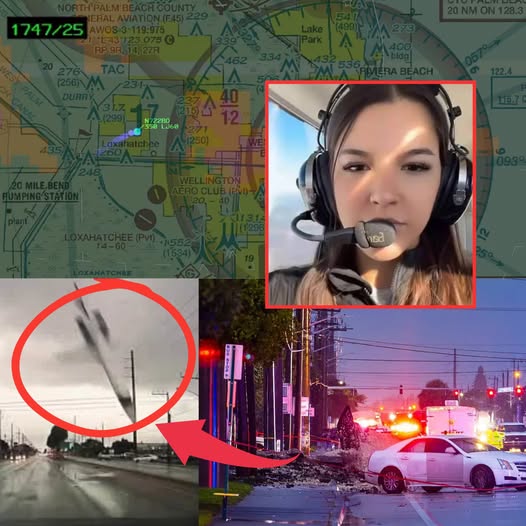 THE WORDS THAT LEFT AVIATION OBSERVERS SEARCHING FOR ANSWERS
As the aircraft continued descending, the crew reported a descent rate reaching approximately 22,000 feet per minute and a bank angle of around 60 degrees.
The recording captures increasingly urgent communications, including a warning that the aircraft was going to 𝔠r𝘢sh.
Then came the words that have attracted so much attention:
“LOOK OUTSIDE, JEFF. LOOK OUTSIDE.”
Moments later, the voice reportedly added:
“WE’RE OUT OF TIME.”
The exchange has prompted questions about what the co-pilot was trying to tell the captain.
Was she urging him to look for an external visual reference? Was she trying to draw his attention to something happening outside the aircraft? Or was there another reason for the desperate instruction?
The publicly circulated recording does not provide enough information to answer those questions.
WHAT IS SPATIAL DISORIENTATION?
Spatial disorientation is a recognised aviation hazard.
It happens when a pilot’s brain misinterprets information about the aircraft’s position, movement or attitude.
Under normal conditions, pilots use visual references, flight instruments and information from their inner ear to understand how an aircraft is moving.
But turbulence, poor visibility, darkness, cloud cover and certain flight manoeuvres can create conflicting sensory information.
A pilot may feel that the aircraft is level when it is actually banking, or believe it is climbing when it is descending.
The Federal Aviation Administration warns that these sensory illusions can be extremely dangerous because a pilot may make control inputs based on what the body seems to feel rather than what the instruments indicate.
This is why instrument training and reliable flight references are so important.
In some circumstances, visual references to the natural horizon can help pilots understand the aircraft’s attitude. However, looking outside is not automatically a safe or effective recovery technique in every situation, particularly when visibility is restricted.
And crucially, the phrase heard in the Learjet recording does not establish that either pilot was experiencing spatial disorientation.
WHAT INVESTIGATORS HAVE RECOVERED
The National Transportation Safety Board is continuing to investigate the 𝔠r𝘢sh.
Investigators recovered aircraft components from both wings, both engines, the flight deck and the aircraft’s tail section.
Parts of the left elevator were also found several miles from the main impact site, raising questions about whether portions of the aircraft separated before it struck the ground.
The cockpit voice recorder was recovered on November 9, 2026, at the initial impact site.
It was transported to the NTSB Vehicle Recorders Laboratory in Washington, D.C., for evaluation.
However, recovering the recorder does not mean investigators have already established what happened inside the cockpit. The agency has not announced a final determination of the cause.
THE QUESTIONS THAT REMAIN
The final radio exchanges have offered a disturbing glimpse into the crew’s last moments, but they do not tell the complete story.
Investigators still need to examine the aircraft’s systems, flight data, weather conditions, recovered wreckage and any usable cockpit voice recorder information.
The role of icing, turbulence, possible structural damage, aircraft performance and crew response remains part of the broader investigation.
For now, the words “Look outside, Jeff” remain an unsettling moment in the recording — one that raises questions but does not, by itself, reveal the cause of the disaster.
The NTSB’s investigation will be essential to understanding what happened aboard N722BD, and why a flight that began as a journey to the Bahamas ended in tᩚraɢedy over Florida.