“LOOK OUTSIDE, JEFF”: THE CO-PILOT’S FINAL DESPERATE WARNING RAISES NEW QUESTIONS ABOUT SPATIAL DISORIENTATION IN FATAL LEARJET 𝔠r𝘢sh
GREENACRES, FLORIDA — “Look outside, Jeff. Look outside.”
Those haunting words, heard in the final moments of a doomed Learjet 60 flight, have become one of the most disturbing parts of the publicly circulated air traffic control recording from a November 1 𝔠r𝘢sh that killed nine people in South Florida.
The voice belonged to 20-year-old First Officer Nathalia Gadelha Filgueiras, who was desperately trying to communicate with Captain Jeff Gregory as their aircraft plunged thousands of feet toward the ground.
Now, aviation experts and experienced pilots are examining the final radio exchanges, trying to understand what the young co-pilot may have been seeing, why she repeated the warning, and whether the crew was facing a dangerous phenomenon known as spatial disorientation.
The questions are particularly troubling because the aircraft had reportedly encountered icing conditions, precipitation and moderate turbulence before its descent suddenly became uncontrollable.
However, investigators have not established that spatial disorientation caused the accident.
 A ROUTINE FLIGHT TURNS INTO A COCKPIT EMERGENCY
The Learjet 60, registered as N722BD and operated by Aurora Aviation under the name Upper Jet, departed Austin-Bergstrom International Airport in Texas on November 1, 2026.
Its destination was North Eleuthera Airport in the Bahamas.
There were nine people aboard: two pilots and seven passengers.
Among the victims were Captain Jeff Gregory, 55, First Officer Nathalia Gadelha Filgueiras, 20, technology entrepreneur Adam Robinson, his wife Helen Sharp, and their two young children.
The aircraft had been flying for nearly three hours when the crew began reporting increasingly difficult weather conditions over South Florida.
According to air traffic control recordings, Nathalia initially communicated with controllers in a relatively calm manner.
She reported light clear icing and moderate turbulence, describing conditions that were becoming increasingly uncomfortable.
The crew subsequently requested permission to climb to flight level 370, approximately 37,000 feet, in an attempt to find better conditions.
Air traffic control approved the request.
But shortly afterward, something went terribly wrong.
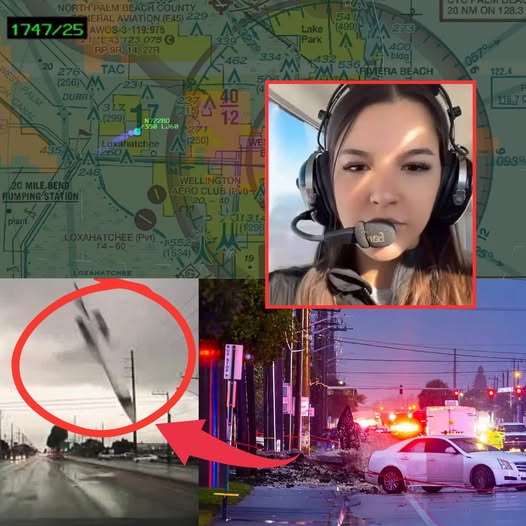 A TERRIFYING DESCENT AT 20,000 FEET PER MINUTE
The aircraft suddenly began losing altitude at an alarming rate.
Nathalia contacted air traffic control and reported that the aircraft was descending at approximately 8,000 feet per minute.
Moments later, the situation became even more ᑕriᩚtiᩚcal.
“Mayday, mayday,” she transmitted.
She then reported a descent rate of approximately 10,000 feet per minute before declaring an emergency.
The next transmission was even more alarming.
“We are in an overspeed condition descending 20,000 feet per minute.”
An overspeed condition occurs when an aircraft exceeds its permitted operating speed. Depending on the circumstances, this can create dangerous aerodynamic loads and potentially threaten the aircraft’s structural integrity.
The controller responded that the crew could choose their altitude and asked what assistance they needed.
But the situation was deteriorating too rapidly.
“We’re going to 𝔠r𝘢sh into the ground,” Nathalia warned.
The aircraft was reportedly descending at approximately 22,000 feet per minute, with the crew also reporting a bank angle of around 60 degrees.
Then came the words that would later capture the attention of aviation observers.
“LOOK OUTSIDE, JEFF. LOOK OUTSIDE.”
Moments later, the recording captured another desperate statement:
“WE’RE OUT OF TIME!”
Communication with the aircraft was subsequently lost.
WHY DID NATHALIA REPEATEDLY TELL THE CAPTAIN TO LOOK OUTSIDE?
The phrase has prompted considerable discussion among pilots and aviation commentators.
One possible explanation involves spatial disorientation, a dangerous condition in which a pilot loses an accurate understanding of an aircraft’s position, movement or attitude.
Under normal circumstances, pilots rely on visual references, flight instruments and their body’s sensory systems to understand whether an aircraft is climbing, descending, turning or flying level.
However, these sources of information do not always agree.
During turbulence, sudden changes in acceleration, poor visibility or flight through clouds, the inner ear can send misleading signals to the brain.
A pilot may feel as though the aircraft is flying straight and level when it is actually banking or descending.
This can lead to extremely dangerous control decisions if the pilot relies on physical sensations rather than reliable flight instruments.
The Federal Aviation Administration has repeatedly warned that spatial disorientation can affect even experienced pilots.
In certain circumstances, looking toward a clearly visible natural horizon can help establish an external visual reference.
That is why some observers believe Nathalia may have been urging Gregory to look outside in an attempt to recognize the aircraft’s actual attitude.
However, there is another possibility.
She may have been attempting to draw his attention to something visible outside the cockpit, such as an approaching hazard or a developing aircraft problem.
Without the complete cockpit voice recording and other flight data, it is impossible to determine exactly what she meant.
Importantly, looking outside is not always the correct recovery response. When the natural horizon is obscured by clouds or poor visibility, pilots must rely on their flight instruments and established instrument-flying procedures.
WHAT IS SPATIAL DISORIENTATION — AND WHY IS IT SO DANGEROUS?
Spatial disorientation is among the most serious hazards in aviation because it can occur without a pilot immediately realizing that anything is wrong.
The human inner ear contains a vestibular system that helps detect movement and changes in orientation.
But during flight, acceleration, banking and turbulence can create sensory illusions.
For example, a pilot experiencing a sustained turn may eventually stop feeling the rotation. If the aircraft then returns to level flight, the pilot may mistakenly feel as though the aircraft is turning in the opposite direction.
Other illusions can make a pilot believe an aircraft is climbing when it is actually descending.
When visibility is limited, the absence of a reliable horizon can make these problems even more dangerous.
The FAA emphasizes that pilots must maintain proficiency in instrument flying and trust reliable flight instruments when visual and physical sensations conflict.
In a rapidly developing emergency, even a brief period of confusion can have serious consequences.
Nevertheless, there is currently no confirmed evidence that either pilot aboard N722BD experienced spatial disorientation.
The phrase heard in the recording alone cannot establish what was happening inside the cockpit.
NTSB RECOVERS THE COCKPIT VOICE RECORDER
The National Transportation Safety Board is continuing its investigation into the 𝔠r𝘢sh.
Investigators have recovered substantial portions of the aircraft, including components from both wings, both engines, the flight deck and several sections of the tail assembly.
Parts of the vertical stabilizer, horizontal stabilizer and left elevator were also recovered.
Some components were found away from the main impact location, raising additional questions about whether the aircraft began breaking apart before reaching the ground.
One of the most important developments came on November 9, when the NTSB confirmed that investigators had recovered the cockpit voice recorder (CVR).
The recorder was found at the initial impact site and transported to the NTSB Vehicle Recorders Laboratory in Washington, D.C., for evaluation.
This is particularly significant because the cockpit voice recorder may provide information about conversations between the pilots, warnings from aircraft systems, cockpit sounds and the crew’s response to the emergency.
The publicly circulated air traffic control recording is separate from the cockpit voice recorder. The latter could provide investigators with a much more complete picture of what happened inside the aircraft.
The agency is also examining recovered aircraft components and the environmental conditions surrounding the accident.
According to the NTSB, the investigation remains ongoing, and the cause has not been determined.
WEATHER, ICING AND POSSIBLE STRUCTURAL FAILURE UNDER INVESTIGATION
Weather conditions are another major focus.
Before the aircraft began its rapid descent, the crew reported icing and turbulence while flying at approximately 35,000 feet.
Investigators are examining the possibility that severe weather, freezing precipitation or other atmospheric conditions may have contributed to the emergency.
A former NTSB and FAA investigator also suggested that components of the aircraft’s tail may have separated during the turbulence or subsequent descent, potentially making the aircraft difficult or impossible to control.
However, this remains an investigative possibility rather than an established finding.
The NTSB must determine whether the aircraft experienced structural damage, a mechanical malfunction, aerodynamic problems or a combination of contributing factors.
A 20-YEAR-OLD PILOT WHO DREAMED OF FLYING
Beyond the technical questions surrounding the 𝔠r𝘢sh, the tᩚraɢedy has also drawn attention to the lives lost aboard the aircraft.
Nathalia Gadelha Filgueiras was just 20 years old.
She developed a passion for aviation at a young age, often accompanying her father, Allan Filgueiras, on flights.
By the time she was 17, she had earned her pilot’s license.
Her father later spoke emotionally about the loss of his daughter, describing her as his soulmate and recalling the special bond they shared through their love of aviation.
Captain Jeff Gregory, 55, was also among those killed.
Seven passengers, including two young children, were traveling aboard the business jet when it crashed near Greenacres, Florida.
All nine people aboard died.
Their families are now left with unimaginable grief as investigators work to understand what happened during the aircraft’s final moments.
THE QUESTIONS THAT REMAIN
The repeated warning, “Look outside, Jeff,” has become a haunting part of the Learjet disaster.
Was Nathalia trying to help the captain overcome a possible spatial illusion?
Was she warning him about something happening outside the aircraft?
Did the crew lose control because of severe weather, structural damage or an unexpected mechanical failure?
Or did several problems develop simultaneously, leaving the pilots with almost no time to respond?
For now, those questions remain unanswered.
The recovered cockpit voice recorder, aircraft wreckage, weather information and flight data will be essential to reconstructing the final moments of N722BD.
Aviation investigators caution against drawing conclusions from isolated audio recordings or online flight reconstructions before the official investigation is complete.
One thing is certain: the final radio transmissions offer a deeply disturbing glimpse into the emergency faced by the two pilots.
And behind every technical question are nine lives lost, families forever changed and a young co-pilot whose final desperate words continue to raise questions about what happened in the cockpit.
The investigation continues. The answers may ultimately reveal not only why the Learjet went down, but also what aviation can learn to help prevent another tᩚraɢedy.