“THREADING A GAP BETWEEN THUNDERSTORMS”: VETERAN PILOT REVISITS LEARJET’S FLIGHT HISTORY AFTER diᩚadℓy FLORIDA 𝔠r𝘢sh KILLED NINE
Did the crew encounter a dangerous combination of thunderstorms, turbulence and icing while trying to reach safer airspace? A new aviation analysis is raising questions about the final flight of Learjet N722BD — and examining an earlier turbulence encounter involving the same aircraft.
New questions are emerging about the final moments of a Learjet 60 that crashed in Palm Beach County, Florida, on November 1, 𝘬iᩚlling all nine people aboard.
In a recent aviation analysis, veteran airline captain and aviation commentator Captain Steeeve revisited the aircraft’s final journey, focusing on the severe weather conditions along its route and the possibility that the pilots were attempting to navigate around developing thunderstorms.
The aircraft, registered as N722BD, was carrying Austin technology executive Adam Robinson, his wife Helen Sharp, their two young children, three other passengers and two crew members.
The flight had departed Austin, Texas, and was heading to North Eleuthera in the Bahamas when disaster struck.
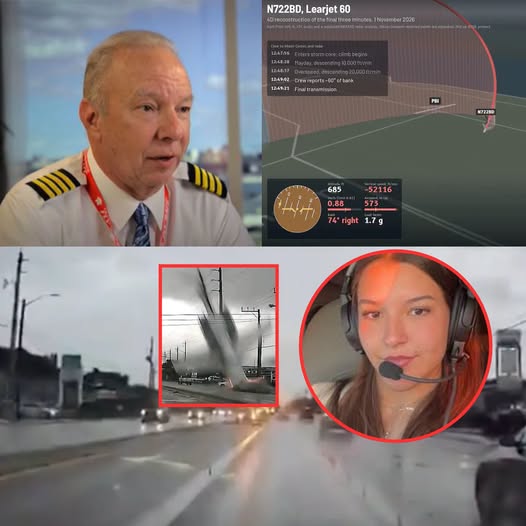 THE CREW REPORTED TURBULENCE AND ICING BEFORE THE 𝔠r𝘢sh
According to information released by the National Transportation Safety Board and reviewed by aviation analysts, the crew encountered challenging weather conditions during the flight.
Air traffic control recordings indicate that the pilots reported light clear-air icing and moderate turbulence.
They also asked about finding smoother conditions and later reported encountering precipitation.
The crew requested permission to climb to 37,000 feet.
Shortly afterward, the aircraft entered a rapid descent. The pilots transmitted a Mayday call as the emergency unfolded.
The sequence has made the weather conditions and the crew’s decisions important areas of investigation.
Captain Steeeve’s analysis examines whether the pilots were attempting to navigate through a narrowing gap between developing storm cells — a difficult situation when thunderstorms are growing and their tops are reaching high altitudes.
However, this remains an interpretation of the available information, not an official finding about what caused the 𝔠r𝘢sh.
 AN EARLIER TURBULENCE ENCOUNTER ALSO DRAWS ATTENTION
The analysis also revisits an earlier reported flight involving the same Learjet in May 2026 near Newark, New Jersey.
According to the account discussed in the review, the aircraft encountered severe turbulence and reportedly struggled to maintain altitude.
The earlier event has attracted attention because it involved the same aircraft months before the fatal Florida accident.
But an important distinction remains: no publicly confirmed evidence has established that the May encounter was connected to the November 𝔠r𝘢sh.
There is also no official finding that the earlier event caused damage that contributed to the later accident.
THE BLACK BOX HAS BEEN RECOVERED
One of the most significant developments in the investigation came on November 9, when the NTSB confirmed that investigators had recovered the aircraft’s cockpit voice recorder.
The recorder was found at the initial impact site and transported to the NTSB Vehicle Recorders Laboratory in Washington, D.C., for evaluation.
Investigators have also recovered and identified components from both wings, both engines, the flight deck and the aircraft’s tail section.
Some recovered components have been sent to NTSB laboratories for further examination.
These findings may help investigators reconstruct what happened during the aircraft’s final minutes.
WHAT INVESTIGATORS STILL NEED TO ESTABLISH
The NTSB is examining several aspects of the accident, including weather conditions, aircraft performance, systems, operating limitations and crew actions.
The investigation must determine whether weather played a role, whether the aircraft experienced structural problems, and what sequence of events led to its rapid descent.
For now, no probable cause has been determined.
Captain Steeeve’s review offers an independent perspective on the available information, but it should not be mistaken for the NTSB’s official conclusion.
Nine people lost their lives in the November 1 𝔠r𝘢sh.
For their families, the search for answers continues — and investigators must determine exactly what happened before the Learjet fell from the sky.