“LOOK OUTSIDE, JEFF!” — CO-PILOT’S HAUNTING FINAL WORDS BEFORE diᩚadℓy LEARJET 𝔠r𝘢sh RAISE NEW QUESTIONS ABOUT WHAT HAPPENED INSIDE THE COCKPIT
“Look outside, Jeff. Look outside.” Those desperate words, heard in the final moments of a doomed Learjet 60 flight, have become one of the most haunting details of the investigation. Now aviation experts are examining whether spatial disorientation, extreme weather conditions or a possible loss of aircraft control could help explain the crew’s desperate final struggle.
The final moments of Learjet 60 flight N722BD are continuing to raise difficult questions among aviation experts and investigators.
On November 1, 2026, the business jet crashed in Palm Beach County, Florida, 𝘬iᩚlling all nine people aboard, including its two pilots.
But it is the aircraft’s final radio transmissions that have drawn particular attention.
Among the most chilling words was a repeated plea from 20-year-old First Officer Nathalia Gadelha Filgueiras:
“Look outside, Jeff. Look outside.”
The words were directed at Captain Jeff Gregory, 55, as the aircraft descended uncontrollably toward the ground.
Why was Nathalia urging the captain to look outside?
Was she trying to help him regain control? Was she reacting to something she could see through the cockpit windows? Or was the crew experiencing a dangerous form of spatial disorientation?
At this stage, investigators have not established the answer.
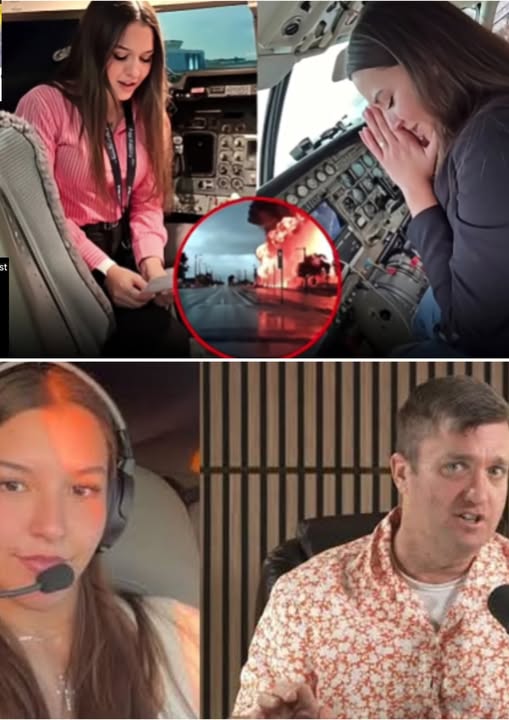 A ROUTINE FLIGHT THAT TURNED INTO A COCKPIT EMERGENCY
The Learjet 60, registered as N722BD and operated by Aurora Aviation, was flying from Austin-Bergstrom International Airport in Texas to North Eleuthera Airport in the Bahamas.
There were nine people aboard: two flight crew members and seven passengers.
During the flight, the crew reported encountering moderate turbulence and light clear icing at approximately 35,000 feet.
The pilots also reported precipitation and requested permission to climb to 37,000 feet in an attempt to find better conditions.
Air traffic control approved the climb.
But shortly afterward, the situation deteriorated dramatically.
The aircraft began losing altitude at an extraordinary rate.
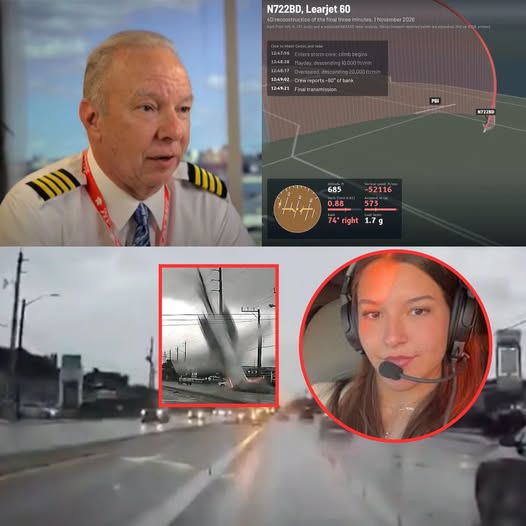
The crew transmitted a Mayday call, reporting a descent of approximately 10,000 feet per minute.
Moments later, the situation became even more alarming.
The cockpit transmission reported an overspeed condition and a descent approaching 20,000 feet per minute.
The crew was no longer dealing with ordinary turbulence.
They were fighting to survive.
 “WE’RE GOING TO 𝔠r𝘢sh INTO THE GROUND”
As the aircraft continued descending, the radio communications became increasingly desperate.
The crew reported that the aircraft was descending at approximately 22,000 feet per minute and banking at around 60 degrees.
The air traffic controller repeatedly attempted to maintain communication, reassuring the pilots that he was still there and asking what assistance they needed.
Then came another devastating transmission.
“We’re going to 𝔠r𝘢sh into the ground.”
The controller responded:
“N2BD, I’m here with you. Talk to me.”
But the aircraft was rapidly approaching the ground.
In the background of the recording, a voice could also be heard appearing to pray.
Then Nathalia’s voice became especially urgent.
“Look outside, Jeff. Look outside.”
A final exclamation followed:
“Holy f***, we’re out of time!”
Communication was subsequently lost.
The entire sequence has become a crucial part of understanding the crew’s final struggle.
WHY WOULD A PILOT TELL ANOTHER PILOT TO “LOOK OUTSIDE”?
One possible explanation being discussed by aviation commentators is spatial disorientation.
Spatial disorientation occurs when a pilot’s perception of the aircraft’s position, movement or attitude conflicts with what the aircraft is actually doing.
In simple terms, a pilot may feel that the aircraft is flying level when it is actually banking, climbing or descending.
This can happen because the human body’s balance system is not designed to accurately determine an aircraft’s orientation during complex movements.
At night, in clouds or in poor visibility, the problem can become particularly dangerous.
A pilot may experience powerful sensations of movement that are misleading.
In certain circumstances, looking at the real horizon can help a pilot establish a visual reference and understand the aircraft’s actual attitude.
This is why some aviation commentators have interpreted Nathalia’s repeated instruction as a possible attempt to direct the captain’s attention outside the cockpit.
However, there is an important distinction.
The phrase itself does not prove that the captain was experiencing spatial disorientation.
Nor does it establish that looking outside would have corrected the aircraft’s flight path.
The exact meaning of Nathalia’s words remains unknown.
COULD ICE AND TURBULENCE HAVE PLAYED A ROLE?
Another major question concerns the weather conditions encountered by the aircraft.
Before the emergency, the crew reported light clear icing and moderate turbulence.
They subsequently reported precipitation and requested a higher altitude.
Ice accumulation can affect an aircraft’s aerodynamic performance by changing the shape of its lifting surfaces.
Depending on the conditions and aircraft systems involved, icing can contribute to reduced performance and increased aerodynamic risk.
Severe turbulence can also create sudden changes in aircraft attitude and airspeed.
But investigators have not established that icing or turbulence caused the Learjet to lose control.
The NTSB is examining the available weather information, aircraft components, flight data and crew communications to determine how these factors may have contributed to the accident.
THE DISCOVERY OF DAMAGED AIRCRAFT COMPONENTS RAISES MORE QUESTIONS
The physical evidence recovered from the 𝔠r𝘢sh site has added another important dimension to the investigation.
Investigators reported recovering portions of the aircraft’s left elevator in multiple pieces, with debris found some distance from the main impact area.
The elevator is a ᑕriᩚtiᩚcal flight-control surface located on the aircraft’s tail.
It helps control the aircraft’s pitch — whether its nose moves upward or downward.
Damage or separation involving this component could have serious consequences for aircraft control.
However, the discovery of separated components does not, by itself, establish why they separated or whether the damage occurred before or during the breakup sequence.
The NTSB is examining the evidence to reconstruct what happened.
THE COCKPIT VOICE RECORDER COULD HOLD CRUCIAL ANSWERS
One of the most important pieces of evidence is the cockpit voice recorder.
Investigators recovered the recorder and are evaluating its contents as part of the ongoing investigation.
Unlike publicly available air traffic control communications, the cockpit recording can potentially provide additional information about conversations between the pilots, warning sounds, cockpit alerts and their responses to the emergency.
It may help investigators establish what the crew was experiencing during the final moments.
Among the questions investigators will need to address:
- Which pilot was controlling the aircraft when the emergency began?
- What warnings or abnormal indications appeared inside the cockpit?
- Did the crew experience an aerodynamic upset or a mechanical failure?
- What did Nathalia see or understand when she repeatedly urged Jeff to look outside?
- Was there an opportunity to recover the aircraft before the final descent?
These questions remain unanswered.
REMEMBERING NATHALIA FILGUEIRAS
Beyond the technical investigation is the loss of a young woman whose life revolved around aviation.
Nathalia was just 20 years old.
Her father, Allan Filgueiras, later spoke publicly about his daughter and the passion she had developed for flying from an early age.
She began flying with him when she was 12 and obtained her own pilot’s license at 17.
Her father described her as someone who shared his love of aviation and spoke emotionally about the bond they had built.
He said losing her felt like losing his soulmate.
Following the 𝔠r𝘢sh, her family also expressed concern about speculation surrounding her role in the accident, emphasizing the importance of allowing investigators to establish the facts.
Her final radio transmissions have since become part of a much wider discussion about the dangers pilots can face when an aircraft encounters an emergency at high altitude.
THE QUESTION THAT REMAINS
“Look outside, Jeff.”
Those three words have taken on a haunting significance.
They may have been an attempt to help the captain regain his bearings.
They may have referred to something Nathalia could see outside the aircraft.
Or they may have had another meaning that only the cockpit recording and further investigation can clarify.
For now, aviation experts can examine the possibilities, but only the evidence can establish what actually happened.
The NTSB has not announced a probable cause for the 𝔠r𝘢sh.
Nine people lost their lives aboard N722BD.
And until investigators complete their work, the final desperate words from the cockpit remain one of the most troubling unanswered questions surrounding the tᩚraɢedy.